
Last Updated on February 8, 2026 by RADHIKA VATLAM
Backlinks are one of the most crucial components of search engine optimization (SEO). Whether you’re running a blog, an e-commerce store, or a corporate website, understanding backlinks can make a significant difference in your search rankings.
They are essential for improving overall online visibility.
In this comprehensive guide, we’ll break down everything you need to know about backlinks—from what they are to how to build a powerful backlink profile that actually drives results
What Are Backlinks?
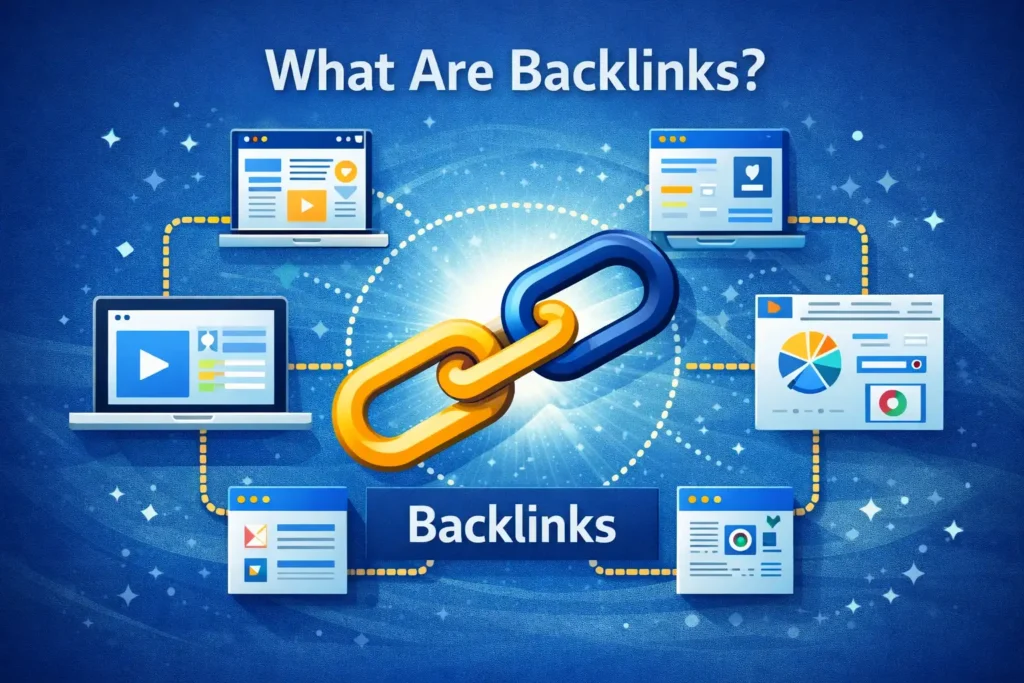
Backlinks, also called inbound links or incoming links, are links from other websites that point to your website. They serve as a signal of trust and credibility.
In the world of SEO, backlinks play a pivotal role.
In search engine optimization (SEO), backlinks act as trust signals. When another site links to your content, it tells search engines like Google that your page provides value, useful information, or credible insights.
Think of backlinks as digital recommendations.
Just like people trust a product that many experts recommend, search engines trust websites that other reputable sites reference.
The stronger and more relevant the linking website is, the more SEO value that backlink passes to you. That’s why backlinks remain one of the most important ranking factors, even in modern algorithms.
A Simple Example
Imagine you publish a detailed guide about digital marketing or web hosting performance. If well-known industry platforms such as HubSpot or experts like Neil Patel link to your article, search engines see that as a strong endorsement.
As a result, your page is more likely to:
- rank higher in search results
- gain organic traffic
- build domain authority
- earn more visibility over time
Why Do Backlinks Matter So Much?
Backlinks aren’t just “nice to have” — they’re one of the core ranking factors in SEO. Even today, search engines rely heavily on links to evaluate which pages deserve to rank higher.
Here’s why backlinks are so powerful:
They not only improve rankings but also drive targeted traffic.
1. They Improve Your Search Rankings
Search engines like Google treat backlinks as signals of trust and credibility.
When multiple relevant websites link to your content, it tells Google:
“This page is useful and worth recommending.”
Pages with strong, high-quality backlinks typically rank higher in SERPs than pages with little or no link authority. Simply put, better links = better ranking potential.
2. They Drive Targeted Referral Traffic
Backlinks don’t just help SEO — they bring real visitors.
When someone clicks a link from another blog, forum, or article, they already have interest in your topic. That means referral traffic often:
- stays longer
- engages more
- converts better
For many sites, a single link from a popular niche website can send consistent traffic for years.
3. They Help Search Engines Discover and Index Your Content Faster
Search engine bots find new pages by crawling links.
If a trusted website links to your new post, crawlers can discover and index it quickly. Faster indexing means:
- your content appears in search sooner
- rankings improve faster
- updates are noticed quickly
This is especially useful for fresh content like tutorials, reviews, or product comparisons.
4. They Build Long-Term Authority
Backlinks compound over time.
As you earn links from trusted and relevant websites, your domain gains stronger authority in your niche. This makes it easier to:
- rank for competitive keywords
- publish new content that ranks faster
- outperform newer competitors
In short, backlinks build your site’s reputation and trust footprint across the web.
What Types of Backlinks Exist?
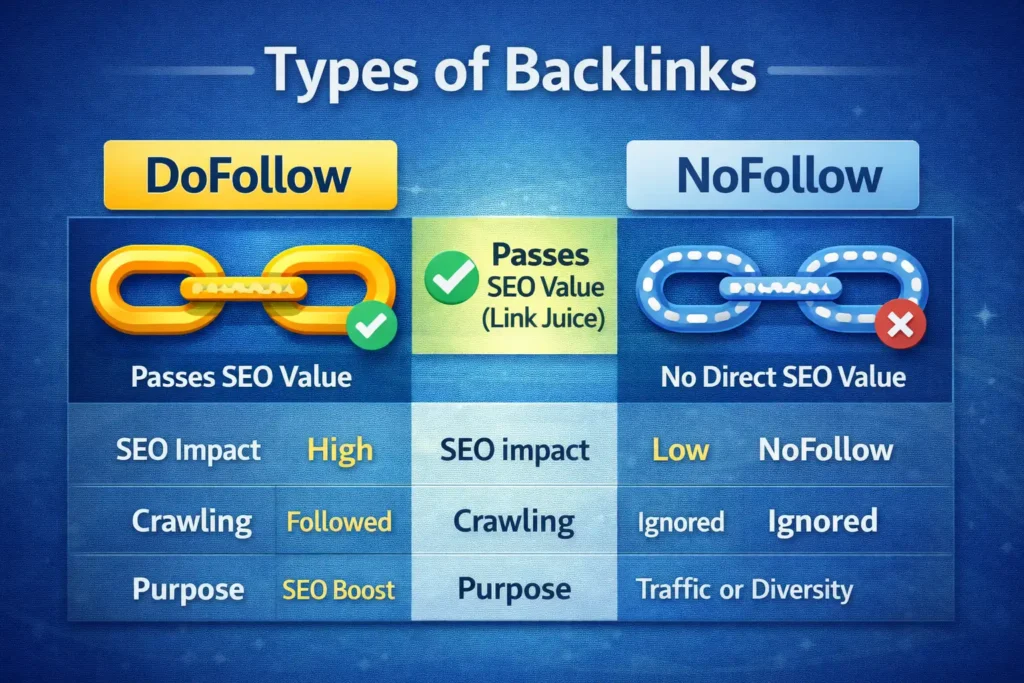
Not all backlinks pass the same SEO value.
Some links can boost rankings significantly, while others mainly drive traffic or simply make your link profile look natural. Understanding the different types helps you focus your efforts on links that actually move the needle.
Here are the most important backlink types you should know:
1. DoFollow Backlinks (Highest SEO Value)
DoFollow links pass authority (often called “link equity” or “link juice”) from the linking site to your site. These directly influence rankings in search engines like Google.
Most editorial links are DoFollow by default, which makes them the most powerful type for SEO.
Best for: Rankings, authority, trust signals
Example: A guest article or blog mention linking naturally to your guide
2. NoFollow Backlinks (Traffic + Natural Profile)
NoFollow links include a rel="nofollow" attribute that tells search engines not to pass full ranking value.
While they may not boost rankings directly, they are still useful because they:
- send referral traffic
- increase brand visibility
- make your backlink profile look natural
A profile with only DoFollow links looks suspicious. A healthy mix is safer and more realistic.
Best for: Traffic, diversity, brand awareness
Example: Links from social media, blog comments, or forums
3. Editorial Backlinks (Most Valuable Overall)
Editorial backlinks are earned naturally, not requested or paid for.
These happen when someone links to your content because it genuinely helped their readers — for example, citing your research, guide, or tutorial.
Search engines trust these the most because they reflect real authority.
Best for: Long-term rankings and credibility
Example: A blogger or journalist referencing your original content
4. Guest Post Backlinks (Controlled + Scalable)
Guest posting means writing content for another website and including a contextual link back to your site.
When done on relevant, high-quality websites, this is one of the safest and most scalable link-building strategies.
The key is quality over quantity — avoid low-quality guest post farms.
Best for: Consistent link building and niche relevance
Example: Publishing a tutorial on an industry blog with an in-content link
5. Resource Page Backlinks (Steady Traffic)
Many websites curate resource or tools pages that list helpful guides and references.
Getting featured here can bring:
- steady referral traffic
- strong contextual relevance
- long-term link stability
These links often stay live for years.
Best for: Evergreen traffic + authority
Example: Your SEO checklist added to a “Best SEO Resources” page
6. Community & UGC Backlinks (Supportive Signals)
Links from communities like Reddit, Quora, or niche forums usually use NoFollow or UGC (User-Generated Content) attributes.
They rarely impact rankings directly, but they:
- drive highly targeted visitors
- increase brand exposure
- add natural diversity
Used properly, they support your overall strategy.
Best for: Engagement and trust signals
Example: Answering a question and linking to your detailed guide
How Many Backlinks Do You Actually Need?
This is one of the most common questions in SEO:
“How many backlinks do I need to rank?”
The honest answer is simple: It’s not about the number — it’s about the quality and relevance of those backlinks.
Search engines don’t count links like votes. Instead, they evaluate who is linking to you and why.
A single strong backlink from a trusted, niche-relevant website can often outperform dozens of weak or spammy links.
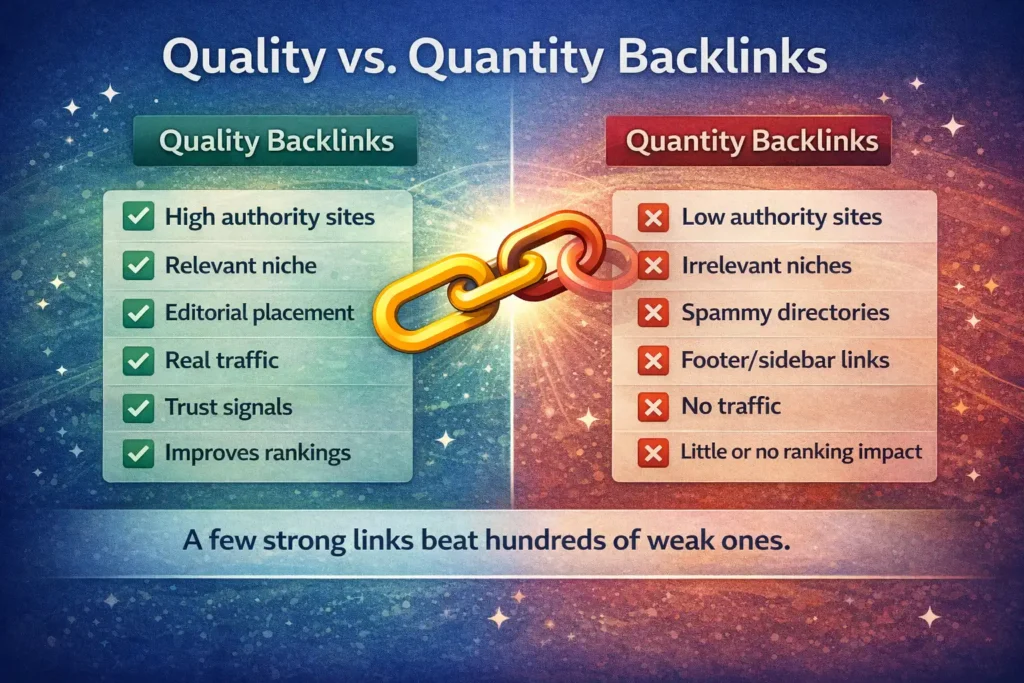
Why Quality Beats Quantity
Search engines like Google evaluate backlinks using multiple signals, including:
- Authority – Is the linking site trustworthy and established?
- Topical relevance – Is it related to your niche or industry?
- Placement – Is the link naturally inside the content or hidden in a footer/sidebar?
- Traffic – Does the site have real visitors?
- Growth pattern – Are links earned steadily or built in suspicious bursts?
Because of these factors, 5–10 strong editorial links can move rankings more than 100 low-quality ones.
So… Is There a “Good Number”?
There’s no universal number because SEO is competitive, not mathematical.
Backlinks contribute to your website’s authority and reputation over time. Understanding their value is crucial for effective SEO strategies.
The right benchmark depends on:
- your niche
- your competitors
- keyword difficulty
- current authority
A smarter approach is to analyze the top 5 ranking competitors and aim to match or slightly exceed their quality links.
That said, here’s a practical framework beginners can follow:
Starter Targets (First Year)
- 15–30 high-quality backlinks
- From relevant, trustworthy websites
- Earned naturally over time (not all at once)
Ongoing Strategy
- 5–15 strong links per month
- Focus on editorial mentions, guest posts, and resource pages
- Build relationships instead of chasing random links
Consistency beats volume spikes.
What Does a “Quality Backlink” Actually Mean?
A strong backlink usually has most of these traits:
✅ Comes from an authoritative site (DA/DR used only as rough indicators)
✅ Topically relevant to your niche
✅ Receives real traffic
✅ Placed naturally inside the content
✅ DoFollow or editorial
✅ Uses contextual, natural anchor text
✅ Not paid or spammy
If a link checks most of these boxes, even a few of them can significantly boost your rankings.
Should You Focus on Quality or Quantity?
When people start building backlinks, one question comes up again and again:
Should you build as many links as possible, or focus only on high-quality ones?
In most situations, quality matters far more than quantity. A few strong, relevant backlinks can often do more for your rankings than hundreds of weak or unrelated ones. Once you build that solid foundation, you can gradually grow your link profile in a natural and sustainable way.
Search engines like Google don’t simply count links — they evaluate trust, relevance, and context.
A Simple Comparison
Let’s look at two typical scenarios.
Website A – Chasing Quantity
- 500+ backlinks
- Low-authority directories and random sites
- Comment links, automated submissions, bulk packages
Outcome:
Little ranking improvement, unstable traffic, and higher risk of algorithm penalties.
Website B – Building Quality
- 70–80 backlinks
- Relevant industry blogs and trusted websites
- Editorial mentions, guest posts, resource links
Outcome:
Higher rankings, steady organic traffic, and long-term authority growth.
Even though Website B has fewer links, it performs better because the links come from credible and relevant sources. Search engines trust those links more.
Why Quantity Still Has a Role
That doesn’t mean you should only have 10 or 20 quality backlinks forever.
A healthy backlink profile also needs diversity and consistency.
Link Diversity
Getting links from different websites looks more natural than receiving many links from the same domain.
Referring Domains Matter More
50 backlinks from 50 unique websites are usually stronger than 50 links from one single website.
Natural Growth
Earning links steadily over time signals that your content continues to provide value. Sudden spikes can look suspicious or artificial.
In other words, quantity supports your strategy — but it should grow naturally, not artificially.
The 80/20 Rule of Backlinks
Most successful websites follow a simple pattern:
- A small number of high-quality editorial links drive most ranking improvements
- The remaining links add diversity, traffic, and trust signals
For example:
If your site has 100 total backlinks:
- Around 15–20 high-quality editorial links might drive most of your rankings
- The remaining 80–85 links mainly add diversity, traffic, and natural signals
So the goal isn’t to collect hundreds of random links.
It’s to first earn those 15–20 powerful, relevant links.
Everything else simply supports that foundation.
So instead of chasing hundreds of random backlinks, focus first on earning a handful of strong ones. Once those are in place, additional links will start accumulating more naturally as your content gets shared and referenced.
Final Takeaway
If you’re choosing where to invest your time and effort:
- Prioritize relevant, authoritative backlinks
- Avoid spammy or low-quality tactics
- Let volume grow gradually and organically
In SEO, a few great links will almost always outperform many weak ones. Quality builds rankings — quantity simply reinforces them.
What Are Spammy Backlinks (and Why Should You Care)?
Not all backlinks help your website.
Some links can actually hurt your SEO performance instead of improving it.
These are commonly called spammy or toxic backlinks — links created purely to manipulate rankings rather than provide real value.
Search engines are smart enough to ignore many low-quality links automatically. However, if your site accumulates too many suspicious or manipulative backlinks, it can still:
- weaken your rankings
- reduce trust signals
- trigger manual reviews
- slow down long-term growth
That’s why keeping a clean backlink profile is just as important as building new links.
Types of Spammy Backlinks to Avoid
Here are the most common link types that provide little to no SEO value — and may introduce risk.
1. Link Farms
Websites created only to publish hundreds of outbound links with thin or useless content.
They exist solely for manipulation and provide zero real authority.
2. Private Blog Networks (PBNs)
Groups of websites built specifically to create artificial backlinks.
While they may work temporarily, search engines actively detect and discount these networks. Long term, they’re risky and unsustainable.
3. Low-Quality Directories
Random directories with no moderation, no traffic, and no niche relevance.
(High-quality listings like business profiles or trusted industry directories are fine — the problem is mass, irrelevant submissions.)
4. Automated Blog Comment Links
Generic comments like “Great post!” followed by a link.
These are easy to detect and rarely pass any value.
5. Sitewide Footer or Sidebar Links
Links placed across every page of an unrelated website (especially in footers or sidebars).
These often look unnatural and carry very little SEO benefit.
6. Completely Irrelevant or Foreign Sites
Links from websites that have nothing to do with your topic or audience.
If you run a hosting blog and suddenly get links from random casino or foreign-language sites, those links won’t help your rankings.
Relevance always matters.
What Should You Do If You Notice Toxic Links?
Don’t panic — most sites naturally pick up some low-quality links over time.
The goal isn’t perfection, but monitoring and cleanup when necessary.
Here’s a safe approach:
Step 1 – Monitor Your Backlinks
Use tools like:
- Ahrefs
- SEMrush
- Google Search Console
Note: In recent years, Google’s algorithms have become much smarter. Most low-quality or spammy backlinks are automatically ignored rather than penalized. This means you usually don’t need to panic about a few bad links — just monitor your profile and focus on earning quality ones.
These help you spot suspicious or irrelevant domains.
Step 2 – Remove What You Can
If a clearly spammy site links to you, you can request removal by contacting the site owner.
(Not always successful, but worth trying.)
Step 3 – Use the Disavow Tool (Only If Necessary)
The below video guides how to Identify & Disavow Toxic Backlinks (Step-by-Step)
If harmful links remain, you can ask Google to ignore them using the Disavow Tool.
This tells Google:
“Please don’t count these links when evaluating my site.”
Using the Disavow Tool incorrectly can do more harm than good, so it’s important to follow best practices. For a complete step-by-step walkthrough, see our guide on how to use Google’s Disavow Tool in 2025.
What Is Domain Authority (DA/DR) — and Does It Really Matter?
When researching backlink opportunities, you’ll often see terms like DA, DR, or Authority Score.
These are third-party metrics created by SEO tools to estimate how strong or trustworthy a website’s backlink profile is.
They’re helpful for quick comparisons — but it’s important to understand one key fact:
👉 Google doesn’t use these scores directly.
Instead, they’re just indicators that help us evaluate link quality.
What Do These Metrics Mean?
Domain Authority (DA)
Created by Moz, scored from 0–100.
Estimates how strong a domain might be based on its backlinks.
Domain Rating (DR)
Created by Ahrefs.
Measures the strength of a website’s backlink profile on a 0–100 scale.
Authority Score (AS)
From SEMrush.
Combines links, traffic, and other signals into one authority metric.
What’s Considered a “Good” Score?
While these numbers aren’t official ranking factors, they can still help you judge link opportunities quickly.
Here’s a rough guideline:
- 70–100: Major publications, strong brands, high trust
- 50–69: Established industry websites
- 30–49: Solid niche sites, good opportunities
- 10–29: Smaller or newer sites
- 0–9: Very new, weak, or potentially spammy sites
But Here’s the Important Part
Authority metrics alone don’t determine backlink value.
Relevance and context often matter more.
A link from a moderately authoritative website within the same niche can provide stronger SEO benefits than a higher-scoring site that is completely unrelated. Search engines evaluate topical alignment and natural placement more heavily than raw authority numbers.
A higher DA or DR doesn’t automatically mean a better backlink.
How to Use DA/DR the Right Way
Think of these scores as:
✔ Quick filters
✔ Comparison tools
✔ Starting points
Not:
❌ Absolute ranking guarantees
❌ The only factor to consider
A practical approach:
- Check relevance first
- Then authority score
- Then traffic and content quality
Simple Rule to Follow
Instead of chasing the highest numbers, aim for:
- Relevant websites
- Real traffic
- Natural editorial links
- Moderate to high authority
A few strong, relevant links will always outperform dozens of weak or unrelated ones.
How Do You Actually Get Quality Backlinks?
Understanding backlinks is one thing.
Earning them consistently is where real SEO growth happens.
The good news? You don’t need complicated tricks or risky tactics.
Most high-quality backlinks come from doing a few proven things well: creating useful content, building relationships, and promoting your work strategically.
Here are the methods that actually work today.
1. Create Content People Naturally Want to Reference
This is the foundation of everything.
If your content isn’t worth linking to, no strategy will work long term.
Focus on assets that provide clear value, such as:
- Original research and data studies
- In-depth guides and tutorials
- Case studies with real numbers
- Free tools, templates, or calculators
- Checklists and step-by-step resources
When your content becomes genuinely helpful, other websites cite it automatically. These editorial backlinks are the most powerful type you can earn.
2. Guest Blogging (Done the Right Way)
Guest posting still works — but only when done selectively.
Instead of publishing on every site that accepts submissions, target relevant, trusted blogs in your niche and contribute high-quality articles that genuinely help their audience.
A few strong guest posts on respected sites are far more valuable than dozens of low-quality ones.
Think quality placements, not volume.
3. Fix Broken Links on Other Websites
Broken link building is simple and surprisingly effective.
Here’s the process:
- Find relevant pages with broken outbound links
- Create or identify similar content on your site
- Politely suggest your link as a replacement
Website owners appreciate the help, and you earn a natural backlink in return.
Tools like Ahrefs or SEMrush make this easy.
4. Build Relationships, Not Just Links
The strongest backlinks often come from relationships.
Engage with:
- bloggers
- journalists
- creators
- industry experts
Comment on their content, share their work, and add value consistently.
When you publish something useful later, they’re much more likely to mention or link to you naturally.
Long-term networking beats cold outreach every time.
5. Promote Your Content Strategically
Even great content won’t earn links if nobody sees it.
Promotion increases visibility and indirectly leads to backlinks.
Share your work on:
- email newsletters
- social platforms
- communities
- industry groups
Links from social platforms are usually NoFollow, but the exposure often leads to real editorial links elsewhere.
6. Reclaim Easy Link Opportunities
Sometimes backlinks are easier than you think.
Unlinked mentions
If someone mentions your brand but doesn’t link, a simple email can turn it into a backlink.
Resource pages & directories
Relevant industry directories or curated resource pages can provide steady traffic and authority.
Avoid mass or generic directories — stick to trusted, niche-specific ones.
Best Practices for Building Backlinks That Last
| ✅ Do | ❌ Don’t |
|---|---|
| Focus on relevance and quality first | Buy backlinks or cheap link packages |
| Earn links from multiple unique domains | Use Private Blog Networks (PBNs) |
| Keep anchor text natural and varied | Spam comments, forums, or directories |
| Monitor your profile using Google Search Console | Exchange links excessively (“you link me, I link you”) |
| Create valuable content first, then do outreach | Chase backlink numbers instead of trust |
| Build relationships with real sites and creators | Over-optimize anchors with exact-match keywords |
Final Tip
Shortcuts may work briefly — but sustainable SEO always wins in the long run.
Focus on earning trust, not gaming the system.
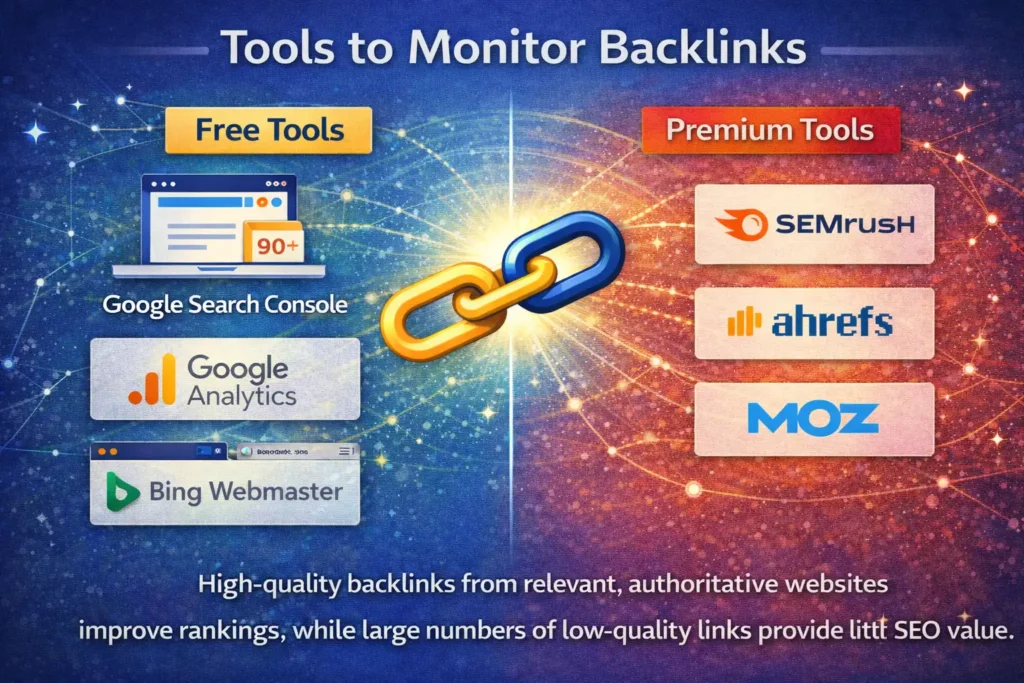
Tools to Monitor and Analyze Your Backlinks
Building backlinks is only half the job.
The other half is monitoring your link profile regularly.
You can’t improve what you don’t measure.
Tracking your backlinks helps you:
- spot new opportunities
- detect lost links
- identify spammy domains
- understand what’s working
- stay ahead of competitors
The following tools help you monitor and analyze your backlink profile effectively.
Free Tools
Google Search Console
This should be your first stop.
It shows:
- backlinks discovered by Google
- top linked pages
- anchor text data
- referring domains
You can also export reports for deeper analysis. It’s free and directly reflects how Google sees your site.
Bing Webmaster Tools
Similar to Search Console but for Bing.
Interestingly, it sometimes reveals backlinks that Google hasn’t reported yet, making it a useful secondary source.
Premium Tools (For Deeper Analysis)
If you’re serious about SEO or competitor research, paid tools provide much richer data.
Ahrefs
Often considered the strongest backlink database.
Great for:
- competitor backlink analysis
- broken link building
- tracking new/lost links
- discovering outreach opportunities
SEMrush
A complete SEO suite with strong auditing features.
Useful for:
- backlink audits
- toxic link detection
- authority tracking
- competitor comparisons
Moz (Link Explorer)
Helpful for:
- tracking Domain Authority trends
- checking link opportunities
- quick domain comparisons
Majestic
Specializes in link intelligence.
Offers:
- Trust Flow & Citation Flow
- historical backlink data
- topical trust categories
Especially useful for evaluating link quality at scale.
What Should You Monitor Each Month?
Tools are only helpful if you check them consistently.
Here’s a simple monthly checklist:
- 📈 New backlinks gained (steady growth is healthy)
- 📉 Lost backlinks (important links disappearing?)
- ⚠️ Suspicious or toxic domains
- 🔗 Anchor text diversity (avoid over-optimization)
- 🌐 Referring domain growth
- 🏆 Competitor backlinks (where are they getting links from?)
Just 15–20 minutes of review each month can prevent problems and uncover new opportunities.
Final Thoughts
Backlinks still play a major role in SEO, but the strategy has evolved.
Focus on earning relevant, trustworthy links through valuable content and real relationships. Avoid shortcuts and manipulative tactics. When your site consistently helps people, links come naturally.
Build steadily, monitor regularly, and think long term — that’s how sustainable rankings are built.
Frequently Asked Questions (FAQs)
1. How many backlinks do I need to rank on Google?
There’s no fixed number. Rankings depend more on the quality and relevance of your backlinks than the total count. A few strong links from trusted, niche websites can outperform hundreds of low-quality links. Always compare your backlink profile with competitors rather than chasing arbitrary numbers.
2. Are NoFollow backlinks useless for SEO?
No. While NoFollow links usually don’t pass direct ranking value, they still bring referral traffic, brand visibility, and natural link diversity. A healthy backlink profile should include a mix of DoFollow, NoFollow, and UGC links.
3. Can spammy backlinks hurt my website?
In most cases, modern Google automatically ignores low-quality or spammy links. However, large-scale manipulative links can still cause issues. It’s good practice to monitor your profile regularly and disavow clearly toxic links when necessary.
4. What is the difference between Domain Authority (DA) and Domain Rating (DR)?
DA and DR are third-party metrics created by SEO tools to estimate a website’s authority based on its backlinks. They are useful for comparison but are not official Google ranking factors. Relevance and content quality matter more than these scores.
5. What’s the fastest way to get quality backlinks?
The most reliable methods are creating valuable content, guest posting on relevant blogs, broken link building, and earning editorial mentions. Avoid shortcuts like buying links or using automated services, as they often do more harm than good.
6. Should I disavow every low-quality backlink?
No. Most low-quality links are automatically ignored by Google. Use the Disavow Tool only for clearly toxic or manipulative links that you cannot remove manually.
7. How often should I check my backlinks?
A monthly review is usually enough. Use tools like Google Search Console, Ahrefs, or SEMrush to track new, lost, and suspicious links.